The nexus of polytechnic education expansion, economic growth, and unemployment: A two-decade perspective in Nigeria
DOI:
https://doi.org/10.59400/jps2993Keywords:
cointegration; education; GDP growth rate; polytechnic expansion; stationarity; unemploymentAbstract
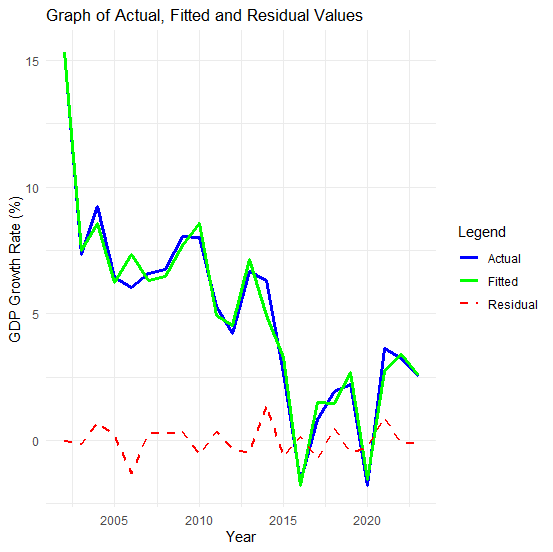
This study explores the dynamic relationship between polytechnic expansion, economic growth, and unemployment in Nigeria from 1999 to 2023 using secondary data obtained from the Central Bank of Nigeria and the National Bureau of Statistics. Key macroeconomic variables analyzed include the Number of Polytechnics (NP), Gross Domestic Product (GDP), GDP Growth Rate (GDPGR), and Unemployment Rate (UNER). Descriptive analysis revealed significant growth in polytechnic institutions, alongside persistent unemployment and fluctuating economic performance. The study employed the Augmented Dickey-Fuller (ADF) test to assess stationarity, followed by a cointegration test and the Autoregressive Distributed Lag (ARDL) model to examine both long- and short-run dynamics. The results confirmed a statistically significant long-run equilibrium relationship among the variables, with the ARDL bounds test yielding an F-statistic of 15.84, surpassing the critical upper bound. Notably, the Number of Polytechnics (log_NP) exhibited a strong positive long-term effect on GDP growth (p = 0.0014), reinforcing the role of technical education in economic development. The error correction term (−0.4819, p = 0.0457) was negative and significant, indicating that deviations from the long-run path adjust moderately at a speed of 48.2% annually. Granger causality analysis further showed that polytechnic expansion Granger causes GDP growth, though not GDP directly, implying indirect effects through skill development and labor market productivity. These findings underscore the importance of aligning technical education with industry needs and improving the employability of graduates. The study recommends policy strategies focused on curriculum reform, funding support, and institutional-industry collaboration to fully harness the growth potential of polytechnic education in Nigeria.
References
[1]Becker GS. Human Capital: A Theoretical and Empirical Analysis, with Special Reference to Education. University of Chicago Press, Chicago; 1964.
[2]Romer PM. Endogenous Technological Change. Journal of Political Economy. 1990; 98(5, Part 2): S71-S102. doi: 10.1086/261725
[3]NBS. Labour Force Statistics: Unemployment and Underemployment Report (Q4 2022). Abuja: National Bureau of Statistics; 2023.
[4]Federal Republic of Nigeria. National Policy on Education. Abuja: NERDC; 2014.
[5]Comfort C. Vocational Technical Education in Nigeria: Challenges and the Way Forward. Business Management Dynamics; 2012.
[6]Tan W. The Development of Construction Education in Singapore. Journal of Construction Research. 2003; 04(02): 207-222. doi: 10.1142/s1609945103000431
[7]National Board for Technical Education (NBTE). Annual Digest of Statistics on Technical Education. Kaduna: NBTE; 2022.
[8]Bukar GM, Timothy YA. Impact of Polytechnic Education on Enterprenuership Development in Nigeria. International Letters of Social and Humanistic Sciences. 2013; 15: 9-21. doi: 10.18052/www.scipress.com/ilshs.15.9
[9]Realinho V, Machado J, Baptista L, et al. Predicting Student Dropout and Academic Success. Data. 2022; 7(11): 146. doi: 10.3390/data7110146
[10]Sadrina S, Mustapha R, Ichsan M. The evaluation of project-based learning in Malaysia: propose a new framework for polytechnics system. Jurnal Pendidikan Vokasi. 2018; 8(2): 143. doi: 10.21831/jpv.v8i2.19100
[11]Akor R, Bakar ARB, Hamzah AB, Rashid AB. Exploring the misrepresentation of Nigerian Women in Technical and Vocational Education in Polytechnic Institution. International Journal of Education and Literacy Studies. 2014; 2(4). doi: 10.7575/aiac.ijels.v.2n.4p.12
[12]Ojo AO. Issues of Vocational and Technical Education. International Journal of Management Sciences and Business Research. 2020.
[13]Adelusi A, Adelusi O. Tvet Financing and Resourcing for The Sustenance of Technological Education in Nigeria (A Study of The Federal Polytechnic Ilaro). International Journal of Scientific Research in Educational Studies & Social Development. 2023; 5(1): 71-82. doi: 10.48028/iiprds/ijsressd.v5.i1.07
[14]El Baradei L, Kadry M. Bridging the Employability Skills Gap in Higher Education. Public Policy HUB, The School of Global Affairs and Public Policy (GAPP), The American University in Cairo, 2022. Available online: https://gapp.aucegypt.edu/public-policy-hub (accessed on 20 January 2025).
[15]Johansen S, Juselius K. Testing structural hypothesis in a multivariate Cointegration analysis of PPP and UIP for UK. Journal of Econometrics. 1992; 53(2): 211-244. doi: 10.1016/0304-4076(92)90086-7
[16]Engle RF, Granger CWJ. Co-Integration and Error Correction: Representation, Estimation, and Testing. Econometrica. 1987; 55(2): 251. doi: 10.2307/1913236
[17]Narayan PK. The saving and investment nexus for China: evidence from cointegration tests. Applied Economics. 2005; 37(17): 1979-1990. doi: 10.1080/00036840500278103
[18]Pesaran MH, Shin Y, Smith RJ. Bounds testing approaches to the analysis of level relationships. Journal of Applied Econometrics. 2001; 16(3): 289-326. doi: 10.1002/jae.616
Downloads
Published
Issue
Section
License
Copyright (c) 2025 Authors

This work is licensed under a Creative Commons Attribution 4.0 International License.
How to Cite